# Active pauses: cognitive benefits of interrupting screen time
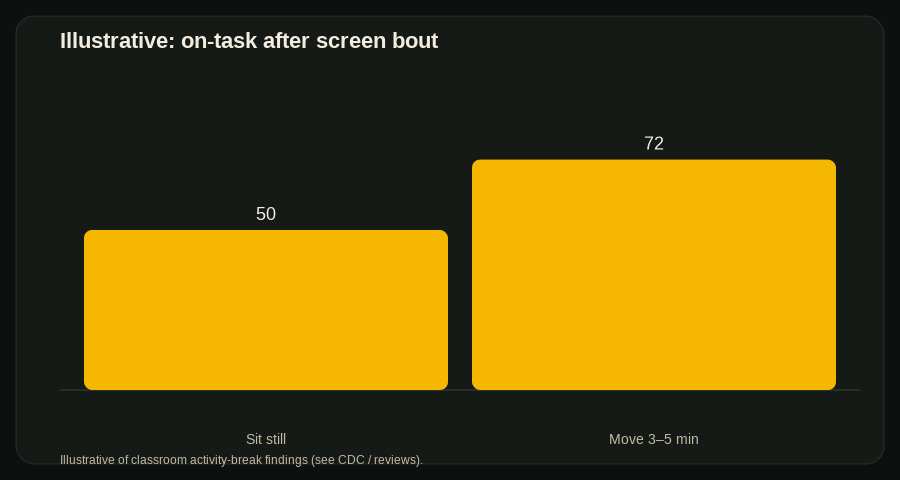
An active pause is a reset — not a punishment for using screens.Illustrative of classroom activity-break patterns summarized by public-health guidance.
After a long YouTube binge, asking for quiet letter practice is optimistic. An
**active pause** — a few minutes of movement — can provide a natural reset after
screen time, making the transition into a short learning activity feel easier.
## What guidance and research actually support
Worth being precise about what's backed by evidence and what's product
hypothesis, because they're not the same claim.
CDC materials on classroom physical activity note that short activity breaks can
support on-task behavior and learning readiness in school settings
([CDC — adding physical activity to schools](https://www.cdc.gov/physicalactivity/basics/adding-pa-to-schools.html)),
and WHO guidelines underscore limiting sedentary time and building movement into
the day ([WHO 2020](https://www.who.int/publications/i/item/9789240015128)).
More recent (2026) reviews of active breaks in children report small but real
gains on executive-function measures — attention and working memory in
particular — though the authors are consistent that effects are modest, vary
with the type and length of the break, and are context-dependent.
Almost all of that evidence, though, is about movement breaks during sedentary
or classroom periods generally — not specifically the sequence of *screen time,
then movement, then a learning task*. That exact chain isn't something the
research has tested directly. So treat the mechanism ("a short move break can
help attention reset") as evidence-supported, and the specific EarnPlay
sequence as a reasonable product hypothesis built on that mechanism — not a
proven effect in its own right.
## Try after each unlock
1. Earn and enjoy the play minutes.
2. When shields return, do 10 jumps, a hallway walk, or stretch together.
3. Only then offer the next earn round — or stop for the evening.
## How EarnPlay fits
The differentiated part isn't the movement — it's that EarnPlay's auto-relock
creates a natural, non-negotiated interrupt in the first place. Nobody has to
say "time's up"; the shield just returns. That interrupt is a built-in cue to
insert an active pause before deciding whether to earn another round.
[EarnPlay](/projects/earnplay).
## References
- CDC classroom physical activity —
- WHO physical activity and sedentary behaviour —